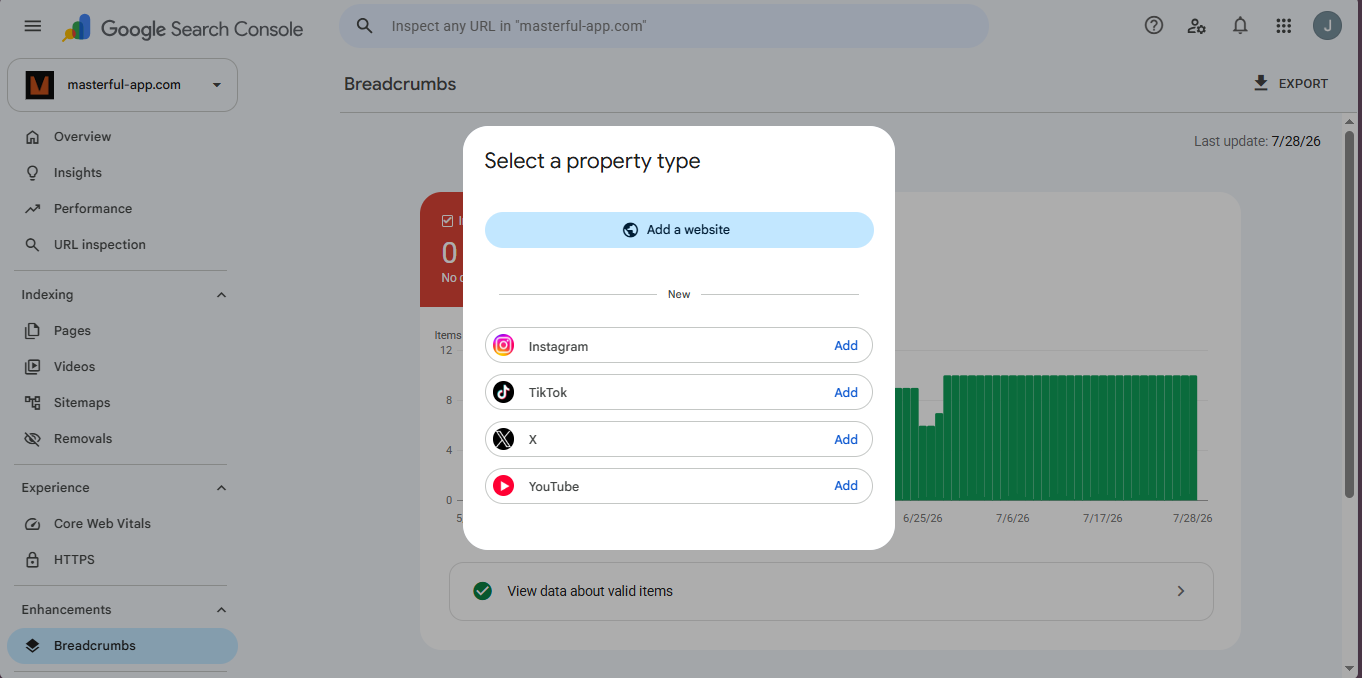
Platform properties are a Search Console property type for social and video accounts. Google announced them on 7 July 2026 and completed the global rollout on 29 July 2026. Four platforms qualify: Instagram, TikTok, X and YouTube. Each account verifies as its own property and returns three reports, Performance, Insights and Achievements, covering Google Search, Discover and Google News. The data excludes on-platform views. A website is no longer required to measure a business's Google presence, which matters most in markets where firms run on Instagram and a phone number rather than a domain.
| Detail | Value |
|---|---|
| Announced | 7 July 2026 |
| Globally available | 29 July 2026 |
| Platforms supported | Instagram, TikTok, X, YouTube |
| Property scope | One property per account, verified one at a time |
| Reports | Performance, Insights, Achievements |
| Surfaces covered | Google Search, Discover, Google News |
| Excluded from the data | On-platform views, reach inside the app |
| History on a new property | Accrues from verification onward, except accounts already under a claimed Google Search profile |
| Roll-up across platforms | None. Export each property and join the files |
| Where to add one | Search Console, Add property, then the platform picker |
Most coverage of this will describe the feature. The part worth arguing about is who it changes the job for.
§ I The prerequisite that disappeared
Until this week, measuring a business's Google presence required a website to verify. No site, no property, no data. That constraint set the shape of every conversation an SEO had with a small business: build the site first, measure second.
The constraint held even when it made no sense. A Nairobi clinic with 12,000 Instagram followers, a WhatsApp number and no domain was already getting found through Google. Someone typed a question, Google showed a social result, and a person tapped through. Nobody could count it. The traffic existed and the measurement did not.
Three Google Search surfaces carry those results. Short videos pulls vertical clips from YouTube Shorts, TikTok and Instagram Reels. Latest posts pulls recent posts tied to an account or a topic. What people are saying pulls firsthand perspectives out of social posts and forums. A business appears in those carousels whether or not it owns a page.
The website was never the search presence. It was the part of the search presence you could measure.
§ II What the three reports hold
| Report | Contents |
|---|---|
| Performance | Clicks, impressions, CTR and average position, broken out by post URL, query, country and device. Exportable. The 24-hour view works here. |
| Insights | A 28-day traffic overview split across Search surfaces, top-performing posts, query groups shown as top, trending up and trending down, and audience countries. |
| Achievements | Milestones against 28-day click totals. |
The data covers Google Search, Discover and Google News. It excludes on-platform views. Say that sentence out loud to a client before you show them a chart, because a business owner reads the word impressions as views, and the gap between those two numbers will cost you the relationship.
Setup runs through Add property in Search Console, then the platform picker, then an on-screen authorisation. One property per account, one at a time. Anyone who already claimed a Google Search profile will find their verified accounts sitting there without doing anything.
§ III Why this lands harder in Nairobi than in Nashville
A med spa in North Carolina has a website. Its Instagram supports the site. Platform properties give that business a second, smaller dataset alongside a first, larger one.
Reverse the ratio and the feature stops being incremental. Across the Kenyan businesses I have researched this year, the pattern repeats: a busy Instagram account, a phone number in the bio, and either no website or a page that has not moved in three years. For those firms, the Instagram account is the search presence. Google has now agreed to report on it.
Two runs from my own notebook, both captured logged out.
On 23 July I asked ChatGPT and Perplexity who the best insurance agencies in Nairobi are. Ten names came back: First Accord, Waumini, Chester, Chancery Wright, Canopy, Midline, Laser, Sunland, Channel and Dawit. Four agencies I had spent that same week researching, each holding a Google rating of 4.9 or 5.0, appeared in none of the answers. Their reviews were better than most of the names on the list. The engines had no reason to know they existed.
The second run was on Kenyan car insurance. ChatGPT named five underwriters and built the answer out of a Nairobi insurance agency's blog post. The agency that supplied the answer appeared as a footnote. The source of the answer was not in the answer.
Both findings describe the same failure: businesses in this market publish where buyers are and stay absent from where buyers ask. Platform properties do not fix the absence. They give you the first measured read on one of the surfaces where it shows up, and a number is what turns a diagnosis into a decision.
§ IV Four analyses worth the time
1. Format comparison
Open comparison mode and group by URL contains. On Instagram, compare /p/ against /reels/. On YouTube, compare /watch against /shorts/. This answers a question no on-platform dashboard answers: which format does Google send people to. A client whose reels win the feed and lose Search has a production decision to make.
2. Query groups
The Insights report carries a card grouping the search terms that reach your content into themes, with top, trending up and trending down views. Caption and hashtag choices come out of that card instead of out of a guess.
3. The 24-hour filter
Open the Performance report, switch to 24 hours, and watch for a post gaining Search traction inside a day. That window is short enough to act on. Cross-promote while the interest holds rather than three weeks later.
4. Annotations
Rewrite a caption or a video title, then drop an annotation on the change date. On a platform where you control no HTML, no canonical and no title tag, an annotation is the one clean way to attribute a copy change to a result.
§ V Four limits to state before anyone misreads a number
- Position and CTR describe the Google result, not the feed. Average position 8 means the social result sat eighth in a Google SERP. It says nothing about reach inside the app.
- One property per account. Google offers no roll-up across platforms, so a cross-platform comparison means exporting each property and joining the files by hand.
- Data starts at verification. A property added today holds no history, with the one exception of accounts already covered by a claimed Search profile.
- Google Trends still covers what has not reached you. Search Console reports demand that found you. Trends reports demand that exists. Run both or you will optimise inside your own footprint.
§ VI Where to start
Nobody holds data on this yet. A platform property accrues from the day you verify it, so anything added this week reads empty until late August. That applies to every account on the platform, which makes the next three weeks the cheapest head start on offer in this market.
If you run a business here with a working Instagram account and no website, four minutes per account is the highest-return use of a morning. Add the property, leave it for one 28-day window, then open the query groups card. The words in it are the words your buyers use.
Then do the part the card cannot do for you. Take the three search terms trending up and ask an AI engine the buying question for your category. If the answer names somebody else, the card has told you what buyers want and the answer has told you who is collecting it.
Jordan | Masterful
Sources
- Analyze your social and video platform content performance in Search Console, Google Search Central, updated 29 July 2026.
- Platform properties, Search Console Help.
- Answer sets captured logged out, Nairobi, 23 July 2026. Masterful field notes.